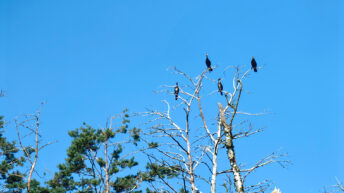

Kąty Rybackie Nature Reserve
Kąty Rybackie Nature Reserve – an ornithological nature reserve on the Vistula Spit, established in 1957 to preserve and protect the natural breeding grounds of the black cormorant and grey heron. The reserve covers an area of 102.54 hectares, with a buffer zone of 62.86 hectares surrounding it.
The reserve is dominated by pine trees, mostly 120–160 years old, with a small number of oaks. In the oldest part of the reserve, pine trees are being replanted after the systematic felling of trees damaged by cormorants. In the understory and ground cover, you can find true raspberry, bindweed, stinking cranesbill, sweet-mountain nightshade, two-spotted pheasant’s-eye, rugose rose, sand-grass, forest old-growth, common bluegrass, common bentgrass, common sorrel, common shepherd’s purse, white goosefoot, and common nettle. Strictly protected plants include creeping creeping grass, common fern, and juniper clubmoss. The ground cover, initially characteristic of crowberry forest, changes after cormorants colonize the trees – initially, the plants are destroyed, followed by mass colonization with species tolerant of intensive guano fertilization, primarily nitrophytes.
The cormorant is a highly versatile waterbird. It is an excellent swimmer and diver, adept at flying, and agilely navigates the tree branches. It often hunts in groups, deliberately and with a division of roles. Its exclusive diet is fish. It forages within a 15-30 km radius of the colony. Adult birds have black feathers with a metallic sheen.
The birds return from their wintering grounds (Germany, France, Spain, Italy, and the northern African coast of the Mediterranean Sea) at the turn of February and March. In March and April, the birds build new nests or repair old ones, while also courting.
Cormorants are monogamous. They lay an average of 3-4 eggs, which are incubated by both sexes for 23-24 days. Zero to three chicks are hatched per pair. Hatching occurs from late April to early June. They are able to fly after 7-8 weeks. The colony usually empties in mid-August.
Cormorants hunt primarily in the Bay of Gdańsk and the Vistula Lagoon, and to a lesser extent in the Vistula Mouth, the Nogat River, and Lake Drużno. Round goby and ruff dominate the cormorant diet.
The cormorant is an endangered species and has been completely exterminated in some countries. In Poland, the cormorant is partially protected. Currently, the cormorant population in the reserve is estimated at approximately 11,000 pairs.
A blue and yellow hiking trail has been marked for visitors in the reserve. Walking off the trails is prohibited.
Hikes related to the tag KĄTY RYBACKIE NATURE RESERVE: