
Kiczora Kocierska Mountain
Kiczora Kocierska Mountain – a two-peaked peak in the Mały Beskid Mountains, in the central part of the Łamana Skała Range. The western peak is at an elevation of 756 m above sea level, and the eastern peak at 746 m above sea level. To the west, it borders Roczenka Mountain, and to the east, via the Rocky Pass, it borders Potrójna Mountain. Its northern slopes descend to the Targaniczanka Stream, while streams flowing down the southern slopes are tributaries of the Kocierzanka Stream.
Kiczora lies within the Silesian Nappe, part of the outer belt of the Carpathians. Its interior is composed of classic flysch, alternating layers of marine sedimentary rocks that were folded and uplifted during the Alpine orogeny.
Unlike the higher, neighboring peaks, Kiczora’s dome and slopes are composed almost exclusively of Godula Beds (Upper Cretaceous). These are hard, fine- and medium-grained sandstones with a characteristic greenish or rusty hue, interspersed with dark clay shales. The hardness of these sandstones protected the ridge from complete flattening by erosion.
The presence of erosion-prone shales gives Kiczora’s slopes a highly sculpted appearance. Numerous streams flowing towards Targanice and Kocierz Rychwałdzki have cut deeply into the mountainsides, creating steep, elongated, V-shaped valleys.
Kiczora is almost entirely forested, with dense, dense forest covering both its summit and the steep slopes. The main plant community covering most of the massif is fertile Carpathian beech forest. Common beech reigns supreme in this stand, accompanied by silver fir in the lower elevations, and sycamore in the wetter gullies and stream valleys. These forests are characterized by a thick layer of litter, providing deep shade in summer and turning bright golden-red colors in autumn.
On the ridge and on some slopes, especially the southern ones, natural beech forests give way to artificial spruce and fir forests. Spruce trees were introduced here in the past as part of former forest management. Due to the shallow, rocky flysch substrate, these coniferous monocultures are now highly susceptible to windfall and natural decay.
The mountain’s landscape once looked different, as its slopes contained large pastoral clearings, such as the Na Skałkach and Pniaki clearings. After the complete cessation of traditional sheep grazing, these areas underwent a process of natural succession and were almost entirely overgrown with young forest, causing the peak to lose its former scenic beauty to a wild, dense forest.
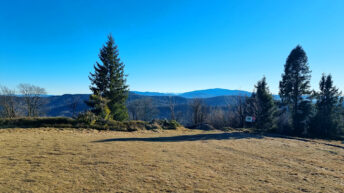
From the summit, fragmentary views of the Żywiec-Orawa Beskid Mountains open to the south.
The red-marked Little Beskid Trail Bielsko-Biała – Luboń Wielki runs through the lower peak of Kiczora.
Hikes related to the object KICZORA KOCIERSKA MOUNTAIN: