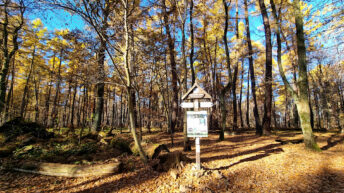

Mount Chełmowa
Mount Chełmowa – a peak at an altitude of 349 m above sea level in the Świętokrzyskie Mountains, located in the western part of the Pokrzywiańskie Range. To the east, it borders an unnamed peak at 318 meters above sea level located in the village of Pokrzywianka. The western slopes descend to the Pokrzywianka River, the northern slopes descend to the village of Cząstków, and the southern slopes descend to the Słupianka River.
Mount Chełmowa is characterized by a bipartite geological structure. The main horst and the entire rock mass of this hill are formed by a deeply buried Paleozoic core dating from the Lower Devonian period, approximately 400 million years ago. This structure is dominated by light-colored quartzite sandstones, which are exceptionally hard and highly resistant to the damaging effects of atmospheric factors. It is thanks to this resilience that, over millions of years of erosion and leveling, the harder rocks have remained in the landscape as a distinct elevation, while the surrounding softer sediments have eroded.
On this old, hard foundation rests a much younger, superficial cover of Quaternary formations, which ultimately shaped the mountain’s modern face. It consists of thick layers of loess, a fine-grained sedimentary rock deposited here during the Pleistocene. Wind carried this dust from areas subject to glaciation, when the Świętokrzyskie region experienced a harsh, Arctic periglacial climate.
The presence of loess is crucial to the present-day ecosystem of Mount Chełmowa, as exceptionally fertile soils developed on this bedrock. These nutrient-rich layers of soil created ideal conditions for the development of the unique vegetation of this enclave of the Świętokrzyski National Park. A prime example of this is the famous natural habitats of Polish larch, which have found excellent living conditions here for centuries. In this way, the original, harsh relief of Devonian quartzites has been softened and enriched by fertile, post-glacial dust.
The forest on Mount Chełmowa is one of the most valuable natural forest complexes in all of Poland. Due to its uniqueness, the country’s first nature reserve was established here in 1920, and thirty years later it became part of the Świętokrzyski National Park as a separate enclave. What makes this place unique is the natural, primeval stand of Polish larch (Larix polonica). This tree has survived here unchanged since the last ice age, becoming a living monument to the region’s natural history.
The main factor contributing to the larch’s thriving growth is the aforementioned loess soil. The fertile, deep, and well-aerated brown soils formed on this post-glacial dust provide the trees with ideal growing conditions. Polish larch grows to impressive proportions here – the oldest, mighty specimens are over 300 years old, and their trunks often exceed a meter in diameter. They are characterized by thick, deeply fissured bark and slightly more delicate needles and smaller cones than the common European larch. Looking up at Mount Chełmowa, one can admire their towering silhouettes dominating the lower forest levels.
The Mount Chełmowa forest community itself is multi-species, with larch co-creating a unique ecosystem with other deciduous and coniferous trees. European beech and silver fir play a significant role in the forest structure, complemented by pedunculate and sessile oaks, sycamores, and hornbeams. This rich species composition makes this forest reminiscent of the ancient, primeval forests that once covered the entire Świętokrzyskie Mountains. The large amount of dead wood, fallen stumps, and ancient trees also creates excellent conditions for the growth of mosses, lichens, and numerous species of birds and insects.
Professor Marian Raciborski played a key role in the discovery and conservation of the Polish larch on Mount Chełmowa. At the turn of the 20th century, he conducted a detailed study of the local old-growth forest, demonstrating that the local specimens differed significantly from the Alpine variety. The botanist identified their unique morphological characteristics, the most important of which was the structure of the cones – they were significantly smaller, more spherical, and their scales were characterized by inward-curving edges.
This pioneering research provided a solid foundation for the scientific identification of a new taxon. In botanical classification, the distinguished professor’s name was forever immortalized in the official Latin name of this unique tree, Larix polonica Racib.
Enchanted by the beauty and rarity of the Świętokrzyskie forest, Raciborski also became a leading advocate for saving it from logging. His passionate appeals for the protection of this site were successful, leading to the establishment of one of Poland’s first nature reserves on Mount Chełmowa in 1920, today a valuable enclave of the Świętokrzyski National Park. To commemorate these great achievements, a stone obelisk dedicated to the scientist now stands at the very summit of the hill.
The black-marked Jerzy Kapuściński Nowa Słupia – Piórków hiking trail runs through the summit of Mount Chełmowa.
Hikes related to the object MOUNT CHEŁMOWA: