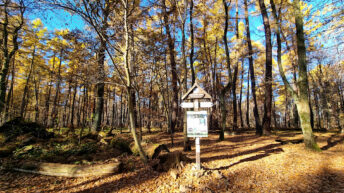

Pokrzywianka Range
Pokrzywianka Range – a range of hills lying between the Pokrzywianka River on the west and the village of Garbacz on the east. It stretches latitudinally for approximately 10 km. The highest peak is Mount Chełmowa, at 349 m above sea level.
The Pokrzywiańskie Range, constituting the northeastern extension of the main ridge of the Świętokrzyskie Mountains, is characterized by a bipartite geological structure. Like the neighboring Łysogóry Range, it belongs to the so-called Łysogóry region and reflects the turbulent tectonic history of the area. Its contemporary relief – with gentle slopes and a few prominent peaks, such as Chełmowa Góra (348 m above sea level) and Serwis (342 m above sea level) – is a direct result of the varying resistance of the rocks that comprise it.
The hard skeleton and core of the entire range are formed by Paleozoic sedimentary rocks, primarily from the Lower Devonian period (approximately 400 million years ago). This structure is dominated by massive beds of light-colored quartzite sandstones, interspersed with mudstones and claystones. These quartzite sandstones, due to their extreme compactness and hardness, are remarkably resistant to weathering. As a result of long-term denudation and erosion processes that destroyed the softer surroundings over millions of years, Devonian sandstones formed the present-day ridge of the Pokrzywiański Range, creating so-called hardwoods. In some places, this bedrock is exposed at the surface, and at the foot of the slopes, it merges with older Silurian sediments, represented by the erosion-prone Silurian shales.
On this old Paleozoic bedrock rests a thick, much younger cover of Quaternary sediments, which decisively influences the range’s present-day landscape. During the Pleistocene glaciations, winds blowing from the front of the glacier deposited massive layers of loess on the northern and eastern slopes of the range. This fine-grained aeolian dust covered the older rocks with a thick layer, softening the sharp contours of the Devonian bedrock. The presence of loess resulted in the development of very fertile brown soils in the Pokrzywiańskie Range, which favor the development of rich mixed and deciduous forests, including beech, fir, and unique natural stands of Polish larch.
The range is crossed by the black-marked Jerzy Kapuściński Nowa Słupia-Piórków hiking trail and the blue-marked Stanisław Jeżewski Tarłów-Święty Krzyż hiking trail.
Hikes related to the object POKRZYWIANKA RANGE: