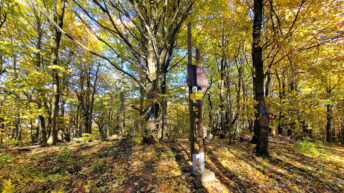

Świerzówka Stream
Świerzówka Stream – a stream approximately 9 km long in the Low Beskid Mountains, a left-bank tributary of the Wisłoka River. It rises on the southern slopes of the Magura and flows into the Wisłoka River in the village of Świątkowa Wielka.
The stream flows southeastward, carving a deep, forested, and exceptionally charming valley. This valley separates the main ridge of the Magura Wątkowska (located to its north) from the isolated massif of the Mareszka and Uherc Mountains, which rise on its southern side.
The village of Świerzowa Ruska, now defunct, stretched from the source of the Świerzówka Stream to the next village, Świątkowa Wielka. It was surrounded by mountains – the slopes of the Magura Wątkowska to the north, the Mareszka to the west, and the peaks of Ostrysz and Kolanin towering on the eastern side.
The village’s name likely comes from the surname of its founder, Świrż. Historical sources relating to the village’s origins are very sparse. It is not known exactly when the village was founded, as there is no charter. It was likely founded in 1574, although the first historical mention dates back to 1665 and appears in the census of the Biecz district. According to oral tradition, the village’s population was of Ruthenian origin. Ruthenians came to Świerzowa from Transcarpathia, having been pushed out by Hungarians (Magyars). According to other accounts (also oral), Ruthenians came from the Dnieper River, escaping the Tatars into the mountains.
In 1680, there were four farms, and less than a century later, in 1765, the village had 27 farms, a sawmill, and an inn. The village’s population was primarily engaged in agriculture, although the local soil was infertile, difficult to cultivate, and required good fertilization. However, the real wealth of the village was the surrounding fir and beech forests.
On July 21, 1770, in the upper part of the village, on the so-called Majdan, a skirmish took place between the Russians and the Confederates, led by Casimir Pułaski. The skirmish ended in Pułaski’s defeat, and he himself narrowly escaped Russian captivity.
Świerzowa Ruska was a royal village, and from 1845 it belonged to August Sterneg, who purchased the land from Józef Lewicki. Subsequently, the village was acquired by Count Antoni Mitrowski, and in 1880 by Jan Lewicki. In 1890, the latter sold it to Countess Franciszka Potulicka from Nowy Żmigród.
In the second half of the 19th century, Majdan housed a farm and a locally renowned potash works, where potash (potassium carbonate) was produced. Its production utilized the ash of deciduous trees, and it was a raw material essential for the production of glass, soap, paints, and detergents. The farm was owned by a Pole, Władysław Marek, who was so fond of the local area and Świerzowa that he requested to be buried in the local cemetery. His wish was granted.
During the interwar period, the village had a two-grade primary school. From 1919 to 1923, the teacher was Josyf Żwiryk, a man of great merit for the village. Until 1933, the school was staffed by Ukrainian teachers, but later, as part of the Polonization of the Lemkos, the Polish authorities ordered their relocation to central Poland (from Świerzowa to the Kielce Voivodeship), and Polish teachers were sent to replace them.
The “Nasz Trud” Cooperative, belonging to the Union of Ukrainian Cooperatives in Lviv, also operated in the village from 1928. In 1933, the village reading room “Prosvita” was established here, soon closed by the Polish authorities on charges of promoting Ukrainian nationalism.
In 1945, the village had 73 households and approximately 450 inhabitants. On June 20th of that year, the village’s inhabitants were expelled to Ukraine. Almost all of them left; only nine remained, who also left the village two years later as part of “Operation Vistula” – for the Recovered Territories (primarily to the Wrocław Voivodeship). Despite attempts to resettle the village, Polish settlers were unsuccessful. Thus, the once vibrant and lively village of Świerzowa disappeared from the face of the earth.
After 1947, the lands of the former village lay fallow, but were soon transferred to the local State Agricultural Farm, which began grazing cattle and sheep, and the local meadows began to be mowed. Slowly, the former village area began to become overgrown, and today it is difficult to imagine a populated settlement in this area. Today, Świerzowa is a completely uninhabited, overgrown valley, with only a few traces of former life: stone crosses hidden in the undergrowth, the remains of cellars, feral trees, and still visible field margins.
Source: Guide to the Świerzowa Ruska Nature and Culture Trail – Magurski National Park. Authors: Bolesław Bawolak, Magdalena Kuś, Jarosław Sochacki.
Hikes related to the object ŚWIERZÓWKA STREAM: