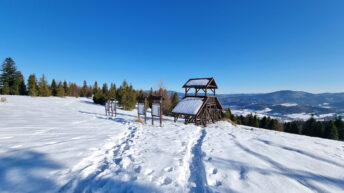

Wielka Racza Group
Wielka Racza Group – a mountain range in the Żywiec-Kysuce Beskid Mountains. It stretches from the Zwardońska Pass in the west to the Glinka Pass in the east. The Zwardońska Pass separates the range from the Jabłonkowsko-Koniakowskie Intermountain, and the Glinka Pass separates it from the Pilska Group in the Żywiec-Orawski Beskids. The main ridge of the Wielka Racza Group is shaped like a broad “U,” opening to the north, where it is bounded by the valleys of the Soła and Ujsolska Rivers (Vistula River catchment). Its southeastern border is formed by the valleys of the Kysuca River and its tributaries, the Skaliczka and Bystrzyca Rivers, while its southwestern border is formed by the valleys of the Biała Orava River and its tributary, the Klinianka River (Danube River catchment). The main ridge of the range from the Zwardońska Pass heads south and, via Kikula (1,087 m), reaches Wielka Racza (1,236 m) and Orło (1,119 m). From there, it turns east and, passing Śrubita Pass (980 m), reaches the peaks of Bania (1,124 m) and Wielka Rycerzowa (1,226 m). Then, further east, it descends to the saddle of Przysłop (940 m) and runs along the hump of the Beskid Bednarów (1,093 m), rising to the lower peak of Oszus (1,147 m). Here it turns north and passes several indistinct hills, including Solisko (1,031 m), gradually descending towards Glinka Pass. Extensive side arms branch off from the main ridge, including Oźna (952 m), Bendoszka Wielka (1141 m), and Muńcuła (1165 m), which gives the Wielka Racza Group its distinctive, forked ridge system.
The Wielka Racza Group is composed of Carpathian flysch formations belonging to the Magura Nappe. Its basement is composed of alternating layers of sedimentary rocks – primarily sandstones, shales, and marls – which were deposited in a former marine basin at the turn of the Cretaceous and Paleogene, and were then folded and thrust northward during Alpine movements.
The final shape of the terrain was determined by selective erosion. Thick-bedded, weathering-resistant Magura sandstones formed the highest ridges and peaks of the range (including Wielka Racza and Wielka Rycerzowa). In turn, softer, more erosional shales were more easily cut by water, creating passes and deep river valleys.
Widespread landslide processes are also a significant element of the geology of this area. The alternating layering of permeable sandstone and impermeable shale, combined with significant slope inclination and heavy rainfall, favors the formation of numerous landslides, niche depressions, and unique rock formations.
The forests in the Wielka Racza Group form an almost continuous, dense forest complex covering the slopes from the valley floors to the highest peaks. Their structure is stratified: in the lower parts (lower montane zone), mixed forests with a predominance of beech, fir, and spruce (Carpathian beech forest) predominate, while on the highest peaks, above 1,150 meters above sea level, pure spruce forests occur (upper montane zone).
The structure of the local forests underwent significant transformations in the 19th and 20th centuries, when natural beech forests were cleared to accommodate spruce plantations. However, spruce monocultures proved susceptible to drought, strong winds, and bark beetle attacks, necessitating the ongoing gradual reconstruction of the forests toward their original, mixed composition.
Despite past logging, unique, primeval fragments of the former Beskid forest have survived in the so-called Worek Raczański region. The most valuable old-growth fir, beech, and spruce stands are strictly protected in nature reserves, including the renowned Śrubita, Oszast, and Dziobaki reserves.
The highest peak of the range is Wielka Racza (1,236 m above sea level).
Hikes related to the object WIELKA RACZA GROUP: