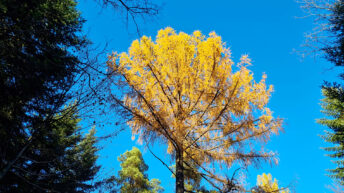

Ciechostowice Nature Reserve
Ciechostowice Nature Reserve – a forest reserve in the southern part of the Gielniów Hillock. Administratively, it is located in the Bliżyn commune, Skarżysko County, Świętokrzyskie Voivodeship. It was established in 1953 and currently covers an area of 7.72 hectares. The reserve was established to preserve, for scientific and educational purposes, a fragment of mixed forest with a significant admixture of endemic Polish larch.
The reserve is located in an area naturally home to Polish larch, fir, beech, yew, Norway spruce, and small-leaved and large-leaved lime trees. In the first half of the 19th century, Polish larch attracted intense interest among Polish botanists and foresters. The main area of this species’ occurrence in Poland remains in the area around Majdów.
Larchs, like other common conifers, belong to the pine family, subfamily Larix. They differ from other trees in the pine family, as well as other Polish coniferous species, in that they shed their needles in winter. In autumn, the needles turn a light, yellowish-brown color. The mixed forests of Ciechostowice, where larches occur, become more colorful, and even the free-standing trees are very beautiful at this time. In spring, larches are distinguished by their light green, celadon-green color. In summer, they retain their vibrant green needles.
All larches are trees with a characteristic habit, with irregularly spaced branches spread almost horizontally. The genus ranges throughout the cool climate zone of the Northern Hemisphere, with individual species found in Europe, Asia, and America, some reaching the Arctic Circle in the north or the Himalayas in the south. Two larches occur in Poland. Formerly considered two species, they are now considered subspecies within a single species – the European larch (Larix decidua). M. Raciborski was the first to draw attention to the diversity of our larches at the end of the last century, but he did not name the Polish larch he distinguished, noting that it had features similar to Siberian larch. It was not until Z. Wóycicki, in 1912, that he named the larches growing on Chełmowa Mountain in the Świętokrzyskie Mountains, with Raciborski’s permission, Larix polonica Racib.
A year later, W. Szafer provided a species diagnosis of this taxon and indicated differences from related European and Siberian larches. This systematic approach was adopted in 1919 in the first volume of the fundamental, fifteen-volume work “Flora polska,” edited by Raciborski and Szafer. In the 1953 post-war edition of the most popular book with keys and descriptions for plant identification, “Polish Plants,” by W. Szafer, S. Kulczyński, and B. Pawłowski, our larches were presented as two species. Therefore, for many years, both larches were discussed in other publications as separate species. Only recently, as a result of research developments and the harmonization of nomenclature with other countries, and in the latest dendrology textbooks, have our larches been listed as Larix decidua subsp. decidua, or the typical European larch, and Larix decidua subsp. polonica, or the Polish European larch.
Larch wood is very valuable. Its value stems primarily from its exceptional durability and physicochemical properties, which surpass all other Polish conifers. It contains resin and is divided into narrow, light-brown sapwood and broad, red-brown heartwood. Annual growth rings are clearly visible in all cross-sections, while tree rays are invisible to the naked eye. The advantages of this wood were noted already in ancient times, recommending it particularly for bridge construction. In the Middle Ages, larch wood, characterized by high durability and resistance to warping, was used to make special boards for painting pictures.
In the Ciechostowice reserve, only 106 species of vascular plants (including synanthropic species) and 52 species of bryophytes have been recorded. Forest communities with a characteristic composition and structure have developed here. The forest habitat is classified as a mixed upland forest. Currently, the mixed stands consist of silver fir with a share of Scots pine, Polish European larch, and sessile oak. Less common are European beech, Norway spruce, and rowan. Other tree species are sparse, and the shrubs include common buckthorn and elderberry.
Larch wood is highly valuable. Its value stems primarily from its exceptional durability and physicochemical properties, which surpass all other Polish conifers. It contains resin and is divided into narrow, light-brown sapwood and broad, reddish-brown heartwood. Annual growth rings are clearly visible in all cross-sections, while woody rays are invisible to the naked eye. The advantages of this wood were noted in ancient times, and it was recommended especially for bridge construction. In the Middle Ages, larch wood, characterized by high durability and resistance to warping, was used to make special boards for painting.
In the Ciechostowice reserve, only 106 species of vascular plants (including synanthropic species) and 52 species of bryophytes have been recorded. Forest communities with a distinctive composition and structure have developed here. The forest habitat is classified as a mixed upland forest. Currently, mixed stands consist of silver fir with Scots pine, Polish European larch, and sessile oak. Less common are European beech, Norway spruce, and rowan. Other tree species are sparse, and shrubs include common alder buckthorn and wattled elderberry.
The undergrowth is sparse in terms of the number of plant species present. This layer is poorly differentiated depending on light and moisture conditions. Coniferous species, primarily blackberry, are predominant, along with two-leafed lily of the valley, common bracken, reed grass, and glandular blackberry. Other species with high constancy of occurrence but low quantitative share include woody sedge, broad-leaved nectar, and wood sorrel. The moss layer is composed primarily of sagebrush and common buckthorn. Among the mushrooms, we can find: boletus, butter mushrooms, birch boletus, chanterelles, toadstools, and bracket fungi.
The blue-marked Stanisław Malanowicz Trail and the green-marked Przysucha-Mroczków Zapowiedz hiking trail run through the reserve.
Hikes related to the object CIECHOSTOWICE NATURE RESERVE: