

Virtual hike: Hike to the Ciechostowice Reserve, Poland
Route: The border of the villages of Sobótka and Mroczków-Kapturów (295 m a.s.l.; 51.146193, 20.718294) – Ciechostowice Reserve (353 m a.s.l.; 51.153152, 20.730708) – Going off the trail (372 m a.s.l.; 51.160820, 20.748051) – Mroczków, Zapowiedź (325 m a.s.l.; 51.149791, 20.737922) – Mroczków-Kapturów (294 m a.s.l.; 51.145911, 20.718080)
Trail designation: blue trail, black trail, roads and paths marked on the map
Length: about 7.7 km
Walking time: about 2:40 h
Sum of approaches: 70 m
Sum down: 70 m
00:00:17 The border of the villages of Sobótka and Mroczków-Kapturów
00:41:18 Blue trail, green trail
00:44:28 Ciechostowice Reserve
01:00:20 Monument to the memory of partisans who died during World War II
01:13:09 Going off the trail
01:57:47 Blue trail, black trail
02:02:28 Mroczków, Zapowiedź
02:19:46 Going off the trail
02:28:41 Mroczków-Kapturów
Ciechostowice Nature Reserve – a forest reserve in the southern part of the Gielniów Hillock. Administratively, it is located in the Bliżyn commune, Skarżysko County, Świętokrzyskie Voivodeship. It was established in 1953 and currently covers an area of 7.72 hectares. The reserve was established to preserve, for scientific and educational purposes, a fragment of mixed forest with a significant admixture of endemic Polish larch.
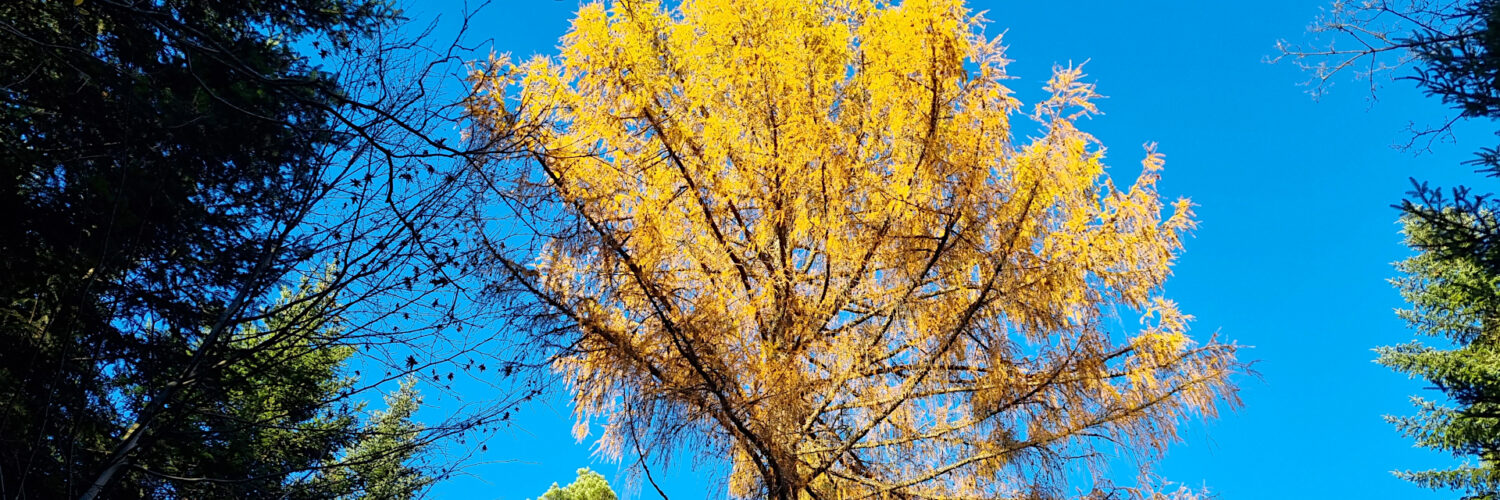
The Ciechostowice Reserve lies in the main natural habitat of Polish larch in Poland, encompassing the area around Majdów. This tree, distinguished by its irregular, horizontal branches, is unique among native coniferous species in that it sheds its needles in winter – they turn yellow-brown in autumn and light green in spring. Although Polish botanists historically considered them a distinct species, modern taxonomy classifies them as a subspecies of the European larch (Larix decidua subsp. polonica). Since ancient times and the Middle Ages, the wood of this tree has been highly valued for its durability and resistance to warping, making it a popular choice for bridge construction and as a substrate for paintings.
In terms of nature, the reserve represents a mixed upland forest habitat, with 106 species of vascular plants and 52 species of bryophytes recorded. The main stand of trees here is composed of silver fir, accompanied by Scots pine, Polish larch, and sessile oak, and to a lesser extent also by beech, spruce, yew, and linden trees. The forest floor is relatively sparse and dominated by coniferous species such as bilberry, lily of the valley, common bracken, and reed grass. The lowest forest layer is composed primarily of mosses, dominated by the common sedge moss and the common sedge moss.
The blue-marked Stanisław Malanowicz Trail and the green-marked Przysucha-Mroczków and Zapowiedz hiking trails run through the reserve.
The hike was recorded on November 6, 2025.