
Gielniów Hillock
Gielniów Hillock – a physiogeographic mesoregion in the northern part of the Kielce Upland. It encompasses a belt of hills stretching from the southeast (from Skarżysko-Kamienna) to the northwest (to Gielniów). It borders the Opoczno Hills to the west, the Suchedniów Plateau to the south, the Iłżec Foothills to the east, and the Radom Plain to the north. It covers an area of approximately 515 km². The highest peak of the Gielniowski Garb is Altana Hill, which rises to 408 meters above sea level.
Geologically, the Gielniowski Garb constitutes the northwestern element of the Mesozoic margin of the Świętokrzyskie Mountains, and its contemporary terrain directly reflects the varied resistance of the rocks that comprise it. The structural core of this region is formed by sediments from the Triassic-Jurassic transition, dating back approximately 200 million years. The dominant feature is a massive series of Rhaetian-Liassic sandstones, interspersed with layers of clay and sandy-clay shale. These formations formed under specific terrestrial and deltaic conditions, as deposits from former rivers, lakes, and coastal floodplains, as evidenced by the ancient stratification structures visible in the rocks.
The tectonic structure of the Gielniowski Garb is characterized by a gentle dip of rock layers toward the northeast. To the east, the region is separated from the neighboring Iłżec Foreland by a distinct tectonic threshold, the relative height of which can reach over 100 meters. Because the hard Liassic sandstones are highly resistant to destructive processes, clays have been stripped away in areas susceptible to weathering, exposing spectacular rock formations and monadnocks, a classic example of which is the nearby Piekło Rocks near Niekłań. In the depressions, this older, Mesozoic substrate is often heavily overlain by younger Quaternary sediments, such as boulder clays, glacial sands, and local patches of loess.
The specific nature of the local sedimentary rocks has had a profound impact on the region’s history and economic development. The Lower Jurassic formations are rich in siderite concretions, iron-rich ores that for centuries provided the raw material base for the Old Polish Industrial Region. Traces of former open-pit and shaft mining, in the form of former spoil heaps and sinkholes, are still clearly visible in the local forest complexes. Furthermore, the local Liassic sediments possess unique paleontological value, as the marshy environments of the early Jurassic period are well-preserved for traces of dinosaur habitats, a spectacular example of which are the footprints discovered in the neighboring Sołtyków reserve.
The Gielniowski Garb is characterized by a very high forest cover rate, and the local forest complexes are a direct extension of the former Świętokrzyskie Forest. The largest dense forest areas stretch across the western and southern parts of the region, forming the picturesque Przysucha Forests and Koneckie Forests. Due to the diverse geology and varied topography, the vegetation in this area is exceptionally rich, combining lowland elements with submontane and mountain species.
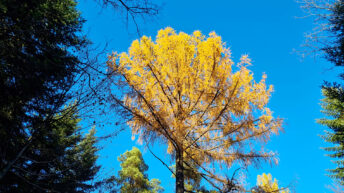
The dominant forest type is mixed forest, with silver fir and European beech playing a key role in its species composition. These trees find optimal growth conditions here, reaching impressive sizes and marking the northern limit of their continuous range in Poland. Scots pine, pedunculate oak, and sessile oak also occur in abundance in the stands, while in the wetter river valleys and lowlands, riparian forests and alder forests with black alder and common ash have developed. A unique element of the local flora is the Polish European larch, whose natural habitats are protected in local reserves.
The undergrowth and undergrowth layers of the Gielniowski Garb are home to many protected and rare species. The dry, sandy hills are dominated by poor coniferous forests with carpets of mosses and bilberries. On the more fertile brown soils, associated with clay outcrops, flourish floristically rich oak-hornbeam forests and fertile beech forests, where wood anemones, common hepatica, daphne, and common ginger bloom in large numbers in spring. Rare clubmoss, wood cnidarians, and numerous fern species can also be found in the damp valley floors.
The Gielniowski Garb landscape is upland and hilly, with a dynamic topography that contrasts markedly with the neighboring lowlands. The region’s main feature is an elongated ridge of hills, with the highest peak, Altana, cut through by a network of river valleys, gorges, and ravines. Because hard Liassic sandstones resist erosion more strongly than softer clays, picturesque natural rock formations and monadnocks have developed on the hillsides.
The visual dominant feature of this area is the massive, dense forest complexes of the former Świętokrzyskie Forest, which cover most of the hills. The dark green of fir forests blends with lighter beech and oak forests, giving the higher elevations a unique, submontane character.
In the lower reaches, the forest landscape gives way to a mosaic of fields and meadows clustered around the river valleys of the Radomka, Drzewiczka, and Czarna Konecka. The space is complemented by numerous anthropogenic traces of the former mining industry of the Old Polish Industrial Region, such as goafs, spoil heaps and former Stasziców ponds hidden in the forests, which today constitute a natural element of the environment.
Hikes related to the object GIELNIÓW HILLOCK: