

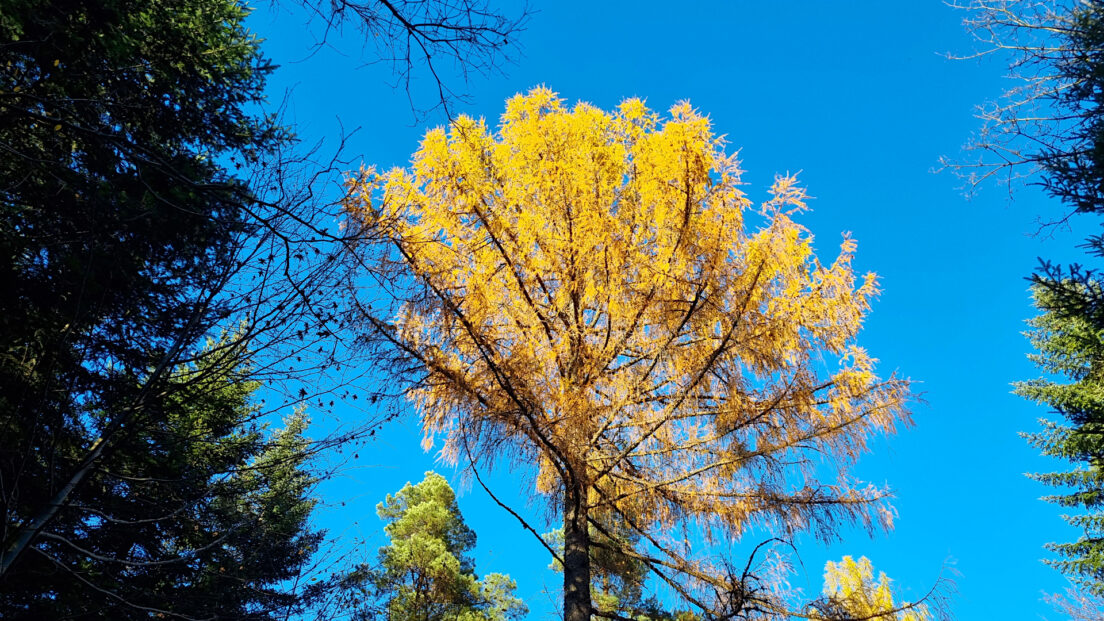
An autumn hike to the Ciechostowice Nature Reserve on the Gielniowski Garb. We set off from a clearing on the border of Sobótka and Mroczków-Kapturów. We enter the forest, where, alongside firs, beeches, and spruces, Polish larch grows in abundance. At this time of year, its needles turn...
Region: Gielniów Hillock
Gielniów Hillock – a physiogeographic mesoregion in the northern part of the Kielce Upland. It encompasses a belt of hills stretching from the southeast (from Skarżysko-Kamienna) to the northwest (to Gielniów). It borders the Opoczno Hills to the west, the Suchedniów Plateau to the south, the Iłżec Foothills to the east, and the Radom Plain to the north. It covers an area of approximately 515 km². The highest peak of the Gielniowski Garb is Altana Hill, which rises to 408 meters above sea level.
The Gielniowski Garb is a hilly and upland region constituting the Mesozoic margin of the Świętokrzyskie Mountains, with the highest peak being Altana. Its varied landscape is dominated by an elongated ridge of hills dissected by river valleys (including the Radomki and Drzewiczki Rivers) and numerous rock formations. The geological core of the area is formed by sediments from the Triassic/Jurassic turn – primarily erosion-resistant Rhaetian-Liassic sandstones, interspersed with soft clays and shales. These formations are rich in iron ore (siderites), which for centuries formed the basis of the Old Polish Industrial Region, while the spoil heaps and sinkholes left by mining operations still blend into the surroundings. Furthermore, these deposits are famous for their unique fossilized dinosaur footprints.
This area is distinguished by its exceptionally dense forest cover, and the local forests (including the Koneckie and Przysucha Mountains) are a direct extension of the former Świętokrzyskie Forest. Mixed forests with a unique, submontane character dominate here, with silver fir and European beech playing a key role, marking the northern limit of their dense range in this region. They are accompanied by pines, oaks, and the rare Polish European larch. Depending on the soil type, the vegetation varies from sparse coniferous forests with bilberry on sandy soils to floristically rich oak-hornbeam forests and fertile beech forests on clayey soils, where protected species such as daphne, clubmoss, and sylvatica sylvatica are abundant.
Hikes in the Gielniów Hillock: