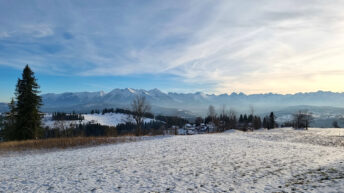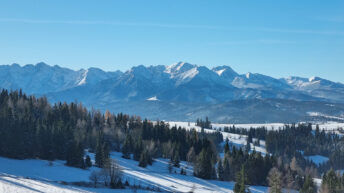

Magura Spiska Mountains
Magura Spiska Mountains – a mountain range in Poland and Slovakia, part of the Spišská Foothills. To the north, it borders the Pieniny Mountains, to the west the Podtatrzańskie Foothills, the Podtatrzańska Furrow, and the Tatra Mountains, to the south the Podtatrzańska Basin in Slovakia, and to the east the Spišsko-šarišské medzihorie and the Levočka Mountains. The highest peak is Rzepisko (1,259 m above sea level), located on the Slovak side, while the highest peak in Poland is Górków Wierch (1,046 m above sea level), located on the Polish-Slovak border.
The geology of the Magura Spiska Mountains is extremely interesting because, despite its name and flysch character, this range is not part of the Outer Flysch Carpathians, but rather part of the Central Western Carpathians. The main building material of this region is sedimentary rocks classified as the Podhale Flysch. They were deposited during the Cenozoic era, specifically in the Paleogene, approximately forty to thirty million years ago. Although flysch is commonly associated with the Beskid Mountains, the flysch that makes up the Magura Spiska differs in its degree of tectonic folding. The rock layers here lie relatively flat or are gently inclined, creating a large geological structure known as the Podhale Trough.
The geological profile of the Magura Spiska is dominated by two main rock complexes, which influence the terrain in different ways. In the lower reaches and valleys, older Zakopane layers occur, consisting primarily of dark clay shales and marls with only thin interbeds of sandstone. These rocks are soft and susceptible to weathering, and therefore have been eroded. The higher ridges and the highest peaks of the range owe their height to the younger Chochołów and Ostryska Beds. They are composed of thick, hard sandstone beds alternating with shale. Because these sandstones are highly resistant to erosion, they form the highest elevations.
Due to the altitude above sea level, two main vegetation zones have developed in the forests of the Magura Spiska Mountains: the lower montane zone and the upper montane zone. However, the natural forest layout has been significantly altered over the centuries by human activity, shaping the region’s present-day mosaic landscape.
Most of the Magura Spiska Mountains is covered by lower montane forests. Originally, fertile Carpathian beech forests dominated here, with a large proportion of silver fir and European beech. However, due to former intensive forest management, the natural deciduous and mixed forests have been replaced in many places by artificially planted spruce monocultures. These spruce forests are proving vulnerable to strong winds and bark beetle attacks, which is why the Spišská Magura forests are currently undergoing a process of reconstruction and natural regeneration. The best-preserved, original fragments of the beech-fir primeval forest can be found in the higher and more difficult-to-access sections on the Slovak side, as well as in the gorge-like river valleys.
The higher elevations of the mountains, exceeding approximately twelve hundred meters above sea level, are covered by the upper montane forest. This is the realm of spruce forests, where the trees become shorter and more resistant to harsh climatic conditions. The undergrowth of these forests is abundant with blueberries – both blackberries and lingonberries – as well as numerous species of mosses and ferns, which tolerate the acidic and moist flysch soil well.
The terrain is formed by long, rounded, and level mountain ridges with domed peaks that stretch for kilometers from west to east. The slopes of the Magura Spiska Mountains range gently descend towards wide river valleys, giving the entire range a peaceful, rolling character. Numerous streams densely dissect the slopes, creating picturesque, secluded valleys.
A particularly important feature of the Magura Spiska Mountains range are the extensive clearings and montane meadows, created as a result of centuries of pastoral activity, locally known as “huts.” These open spaces are home to rich plant communities, including numerous species of orchids, crocuses, and rare grasses. Of particular botanical interest are the enclaves in the northern part of the range, at the junction with the Pieniny Klippen Belt. On the limestone outcrops there, where the substratum is alkaline, a completely different, thermophilic rock vegetation has developed, including rare mountain species and xerothermic grasslands, which contrasts sharply with the acidophilous flysch vegetation of the main ridge.
Hikes related to the object MAGURA SPISKA MOUNTAINS: