
Silesian Beskid Mountains
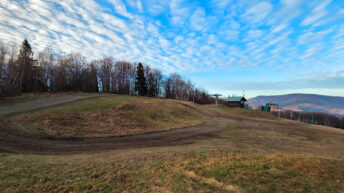
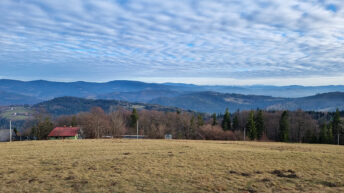
Silesian Beskid Mountains – a mountain range in Poland and the Czech Republic, part of the Western Beskids in the Western Carpathians. Most of it lies on the Polish side, while the western part of the Czantoria Range lies on the Czech side. It borders the Moravian-Silesian Beskids to the west, the Silesian Foothills to the north, the Żywiec Basin and the Żywiec-Orawa Beskid Mountains to the east, and the Jabłonkowsko-Koniakowskie Intermountain to the south.
The Silesian Beskid Mountains are composed of massive Godula and Istebna sandstones. In the southern part, the mountains are composed of Magura flysch. Mineral deposits include sandstones, limestones, and natural aggregates. Godula sandstones are of great importance, occurring in two types: the Middle Godula (mined in two quarries in Brenna) and the Lower Godula (mined in a quarry in Wisła). The Silesian Beskids are home to numerous rock outcrops, some quite extensive. The most characteristic include Dorkowa Skała, Malinowska Skała, rock outcrops on the summit of Kościelec, Krzakoska Skała, rock outcrops in the Malinka Stream Valley, rock outcrops on the slopes of Cieńków Peak, and rock outcrops on the slopes of Malinów Peak. Furthermore, the Silesian Beskids boast the largest concentration of caves in the Polish Beskids, including the two largest caves of the Polish Carpathian flysch: Wiślańska Cave (with corridors measuring 2,275 meters long) and Miecharska Cave (with corridors measuring 1,838 meters long). The Polish Silesian Beskids contain 415 caves and rock shelters.
The Silesian Beskid Mountains consist of two longitudinally extending mountain ranges. To the west lies the Czantoria Range, through which the Polish-Czech border runs, while to the east lies the Vistula Range, which includes several smaller mountain ranges: the Barania Góra and Skrzyczne Ranges, the Równica Range, the Hungarian Beskids, and the Klimczok and Szyndzielnia Ranges.
Forests in the Silesian Beskid Mountains have been significantly transformed by mining. The oak-hornbeam forests, which originally occurred in the foothills, have almost completely disappeared. The area of fir-spruce and spruce forests has increased. The area of lower montane beech forests has decreased. In the stream valleys of the foothills, submontane ash riparian forest, riverside mountain alder forest, and lower montane spruce forest on peat occur. Spruce forests dominate the lower montane zone. In places, beech forests can be found: acidic mountain beech forest and fertile Carpathian beech forest. The steep slopes are covered with mountain maple forests, and in some areas with Carpathian maple forests. In the higher reaches of the lower montane zone, a fir-spruce forest occurs. The upper montane zone is covered with spruce forests, most developed in the nature reserve on Barania Góra. The ridge from Malinowska Skała to Skrzyczne features small areas of artificially planted dwarf pine.
On the slopes of Barania Góra are the headwaters of Poland’s largest river, the Vistula. The headwaters of the Czarna Wisełka are located at an elevation of 1,107 m a.s.l., higher than those of the Biała Wisełka (1,080 m a.s.l.). The Czarna Wisełka has a longer flow, which is why it has been recognized as the main headwater stream of the Vistula.
The highest peaks of the Silesian Beskid Mountains: Skrzyczne 1257 m a.s.l., Barania Góra 1215 m a.s.l., Małe Skrzyczne 1211 m a.s.l., Wierch Wisełka 1197 m a.s.l., Kopa Skrzyczeńska 1189 m a.s.l., Malinowska Skała 1152 m a.s.l., Zielony Kopiec 1152 m a.s.l., Magurka Wiślańska 1140 m a.s.l., Klimczok 1117 m a.s.l., Malinów 1115 m a.s.l., Magura 1109 m a.s.l., Magurka Radziechowska 1108 m a.s.l., Trzy Kopce 1082 m a.s.l., Gawlasi 1076 m a.s.l., Stołów 1035 m a.s.l., Cebula 1035 m a.s.l., Glinne 1034 m a.s.l., Przysłup 1029 m a.s.l., Szyndzielnia 1028 m a.s.l., Kościelec 1022 m a.s.l., Skałka 1020 m a.s.l., Muronka 1017 m a.s.l., Przypiór 1008 m a.s.l.
Hikes related to the object SILESIAN BESKID MOUNTAINS: