
Virtual hike: Descent from Potrójna Mountain through Jawornica Mountain to Targanice, Poland
Route: Potrójna Mountain, northern peak (887 m a.s.l.; 49.780209, 19.367885) – Jawornica Mountain (831 m a.s.l.; 49.798286, 19.346536) – Targanice, Nowa Wieś (477 m a.s.l.; 49.790110, 19.329897)
Trail designation: yellow trail, paths marked on the map
Length: about 4.8 km
Walking time: about 1:30 h
Sum of approaches: 29 m
Sum down: 430 m
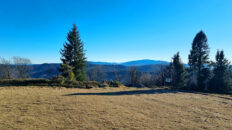
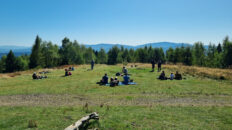
00:00:19 Potrójna Mountain, northern peak
00:57:17 Ruins of a tourist shelter from 1938
00:58:57 Jawornica Mountain
01:12:25 Going off the trail
01:30:12 Stream
01:32:35 Targanice, Nowa Wieś
Jawornica Mountain – a peak at an elevation of 831 meters above sea level in the Beskid Mały Mountains. It is located on a side ridge extending northwest from Potrójna and descending into the Taganiczanka Valley in Targanice. The southwestern slopes descend into the Targaniczanka Valley, while the northeastern slopes descend into the Bolęcinianka Valley.
Jawornica and its ridge are composed of Carpathian flysch belonging to the Silesian Nappe. The massif’s structure is formed by alternating layers of sedimentary rocks that formed millions of years ago on the bottom of a former ocean.
The main building blocks of the highest parts of the peak and the summit itself are the Istebna Beds. They consist of hard, thick-bedded sandstones and conglomerates rich in quartz. The lower and middle sections of the slopes are formed by the Godula layers, represented by fine-grained gray-green sandstones interspersed with soft clay shales.
The presence of weathering-resistant Istebna sandstones acted as natural armor, protecting the Jawornica ridge from rapid erosion. While the adjacent stream valleys were deeply cut into the soft shales, the hard sandstones formed a prominent, visible elevation.
The inclination of the rock layers and the steepness of the slopes favor gravitational processes. Landslide formations and clay-rock weathered covers occur on Jawornica’s slopes, especially from the Targanice side. Local debris of smaller rock blocks can also be found in the sub-peak areas.
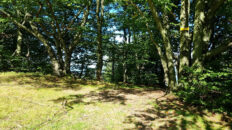
The forest covering Jawornica and its slopes is typical of the lower montane zone of the Beskid Mountains, although the original Carpathian primeval forest here has been significantly transformed by human activity in the past. Today, the forest structure of the massif is diverse and depends primarily on the slope aspect and soil moisture.
The most valuable element is the remnants of the fertile Carpathian beech forest, which dominates the higher reaches of the ridge and on the cooler, northern, and shaded slopes. The dominant tree stand here is common beech, accompanied by silver fir and, occasionally, sycamore (especially in the wetter depressions).
On the other hand, the southern and western-facing slopes (sloping down towards Targanice) are significantly warmer and drier. Here, the beech forest naturally transitions into thermophilic orchid beech or oak-hornbeam forests, where the beeches are accompanied by pedunculate oaks and lime trees.
European larch also grows on Jawornica. Although it is not the main component of the local forests, it occurs on the massif as a valuable admixture species. The appearance of larch on the slopes of Jawornica is largely a result of past forest management. In the 19th and 20th centuries, foresters readily planted it alongside spruces and beeches due to its rapid growth and exceptionally durable, rot-resistant wood. Older, towering specimens can be spotted today, for example, along the yellow trail from Targanice. Larch also thrives as a pioneer plant. Because it loves the sun, it naturally reseeds in clearcuts and windfalls that formed higher up the ridge after the felling of dead spruces.
On the lower slopes and in the more accessible valleys, natural forests were replaced by artificial spruce monocultures in the 19th and 20th centuries. Planted in unsuitable habitats, these spruces are now susceptible to windfalls and bark beetle attacks. As a result, intensive forestry work is underway on the slopes of Jawornica, involving the reconstruction of the forest stand – cutting down diseased spruces and replanting native beeches, firs, and sycamores – to restore the forests to their natural, more resilient character.
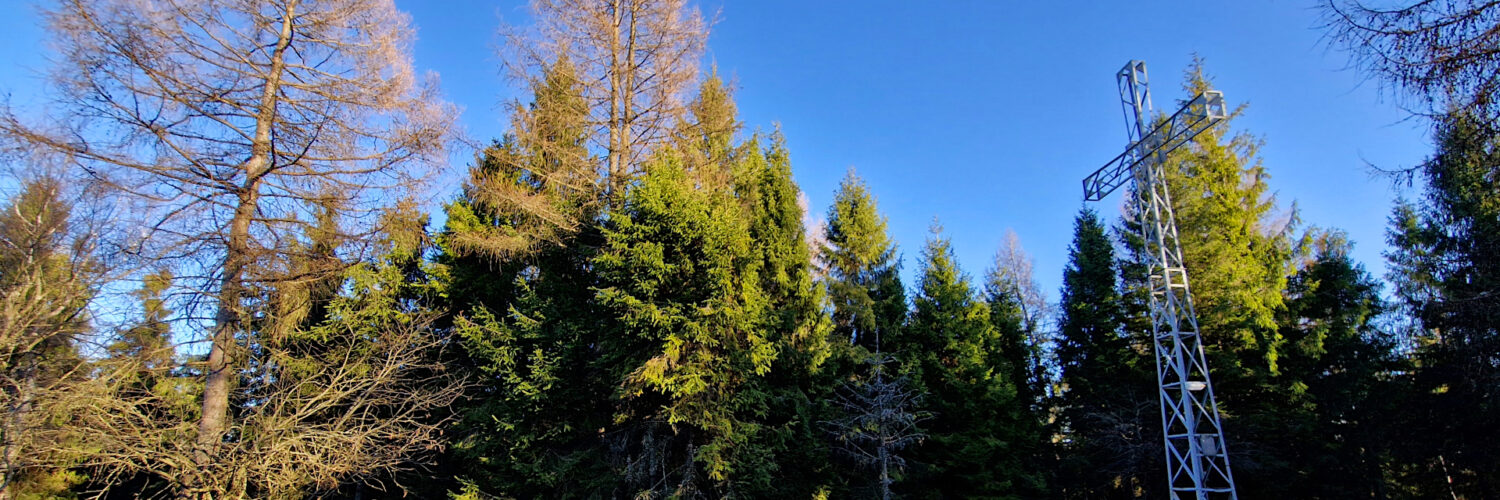
The summit of Jawornica is completely forested and offers no views. A metal cross stands on it, donated to commemorate the deaths of four skiers from the Andrychów “Beskid” Sports Club, who tragically perished on Babia Góra on the night of February 14-15, 1935.
Right next to the summit, there was once a tourist shelter on Jawornica, built before World War II by members of the Ski Section of the “Beskid” Sports Club in Andrychów.
The yellow Porąbka – Rzyki hiking trail runs through the summit.
Hike recorded on December 13, 2025.